The email went out on Monday. The new structure is live, the reporting lines are redrawn, and the slide that explained it all received polite nods. By most measures, the change is done.
Then Thursday arrives. An urgent request sits unapproved because no one is sure who owns it now. A senior team member who used to be consulted on everything goes quiet in meetings. Someone asks a question in the hallway that was answered on the slide. You start to wonder whether people are resisting the change.
Most of the time, they are not resisting. They are still in transition. And that is a different thing to lead.
Change is an event. Transition is a journey.
William Bridges, whose work on managing transitions still shapes how thoughtful leaders approach change, drew a distinction that is easy to miss. Change is the external event: the new role, the merger, the system, the reorganization. It can be announced on a date and finished on a plan.
Transition is the human adjustment to that event. It is learning new responsibilities, revising expectations, and letting go of an identity that used to fit. It happens over time, one person at a time, and no one can announce it into being.
Bridges described three overlapping zones that people move through.
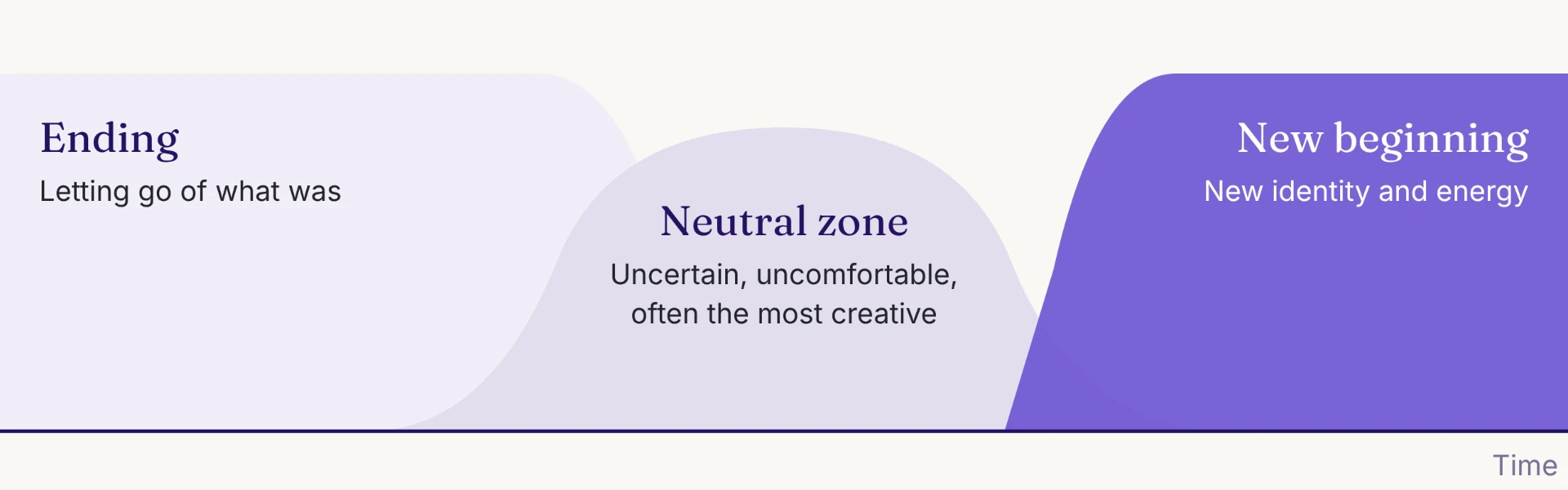
The ending comes first, which surprises people. Before anyone can embrace the new, they have to release something: a routine, a status, a relationship, a familiar sense of being good at their job. Then comes the neutral zone, the uncomfortable in-between where the old way is gone and the new way does not yet feel natural. Only after that does a new beginning take hold.
Leaders usually arrive first
Here is the part that catches capable leaders off guard. By the time you announce a change, you have usually been living with it for weeks or months. You have already grieved what was lost, wrestled with the uncertainty, and found your way to the new beginning.
Your team is hearing it for the first time. They are standing at the ending while you are already waving from the other side.
A finished announcement does not mean the adjustment is finished.
That gap explains a great deal of what gets labeled as resistance. It is not a character flaw in your people. It is a timing difference. And it changes what your leadership needs to do next.
Look beneath the waterline
Every change has a waterline. Above it sits what gets discussed in meetings: the new structure, the new tool, the new process. Below it sits what people actually feel: questions of identity, belonging, competence, status, and control.
A promotion can mean opportunity to one person and the loss of a trusted colleague to another. The same reorganization can feel like freedom to one team member and a quiet demotion to the next. When leaders respond only to what is above the waterline, they answer questions no one is asking and miss the ones that matter.
Leaders have a waterline too. One of the most useful questions you can ask yourself in a transition is this: where am I treating an old success as the answer to a new problem? The skills that earned you this role are not always the ones that will carry your people through it.
Name the real barrier
When a transition stalls, the easiest diagnosis is attitude. People resist change. It feels true, and it gives you almost nothing to work with.
Compare it with this: staff do not know who can approve urgent requests. That is a barrier you can act on. Get specific enough and most stalled transitions turn out to have ordinary causes: unclear authority, too many competing priorities, a gap in tools or access, a fear of losing status or competence, or simple pressure for certainty that no one has addressed.
Then be honest about what you can do about it. Some barriers are within your control: you can make the decision yourself, today. Some require your influence: you need agreement or support from someone else, so the work is knowing who to ask and what to ask for. And some you can only monitor: a central policy or a market condition you cannot change, but can prepare for.
Leaders lose a lot of energy pushing on barriers outside their control while the ones inside it sit untouched. Labeling a structural problem as an attitude problem is one of the quietest ways a transition goes sideways.
Say less certainty, more clarity
Under pressure, many leaders reach for reassurance. There is nothing to worry about. We will work out the details soon. It is kindly meant, and it rarely helps. People do not need you to pretend everything is settled. They need enough clarity to act tomorrow.
A strong transition message has five building blocks, in this order:
- Name the change and its known impact on people.
- Commit to what is dependable within your authority.
- Name what is still open, without inventing certainty.
- Give the next action and who owns it.
- Set an update time, then invite a concern and listen.
It sounds like this: “Our approval structure changes on Monday. We will publish the new decision limits before it begins. Coverage for urgent requests is still being finalized. Until then, send urgent requests to me and copy the operations lead. I will update you at 3 p.m. Friday. What is unclear or likely to create a problem?”
Notice what that message does. It admits a gap, offers a temporary route through it, and promises a specific next conversation. That is what trust looks like in the neutral zone.
Test the next responsible step
The final trap is scale. Once a leader has clarity, the instinct is to roll the new way out everywhere at once. A wiser move is a small, reversible test: one team, seven days, a clear measure, and a condition that tells you to pause.
Small tests protect people from a bad idea at full scale. They also send a message that matters in transition: we are learning this together, and we will adjust based on what we see.
Three questions for this week
If you are leading a transition right now, start here:
- Where are my people, really? Not where the project plan says they should be. Ask one person who has less voice in your meetings what feels most uncertain to them, and summarize what you heard before you offer a solution.
- What am I treating as a fact that is actually an assumption? “Everyone understands the new process because we sent the announcement” is an assumption. Ask people to walk you through a typical decision instead.
- What will be observably different in thirty days? “Lead better” is an intention. “Team members can explain who decides an urgent request” is a result you can check.
From ladder to elevator
At MLYE, we work through transitions using the E.L.E.V.A.T.E.™ method, seven stages that take a leader from insight to action.
We examine what is truly known, locate where progress is stuck, and engage the story beneath the change. We set a vision someone could observe within thirty days, align priorities and the message, transform through a small test, and embody the change until it becomes dependable practice.
But the heart of it is simpler. Your ladder is everything you climbed on your own: the skill, effort, and judgment that brought you here. Transition asks for something more. You are no longer only climbing. You are now responsible for carrying other people with you.
That is the shift from ladder to elevator. It is quieter than an announcement, and it lasts much longer.
You brought the ladder. MLYE is your elevator.
Reference: William Bridges and Susan Bridges, Managing Transitions: Making the Most of Change. The E.L.E.V.A.T.E.™ method is proprietary to My Ladder Your Elevator.